
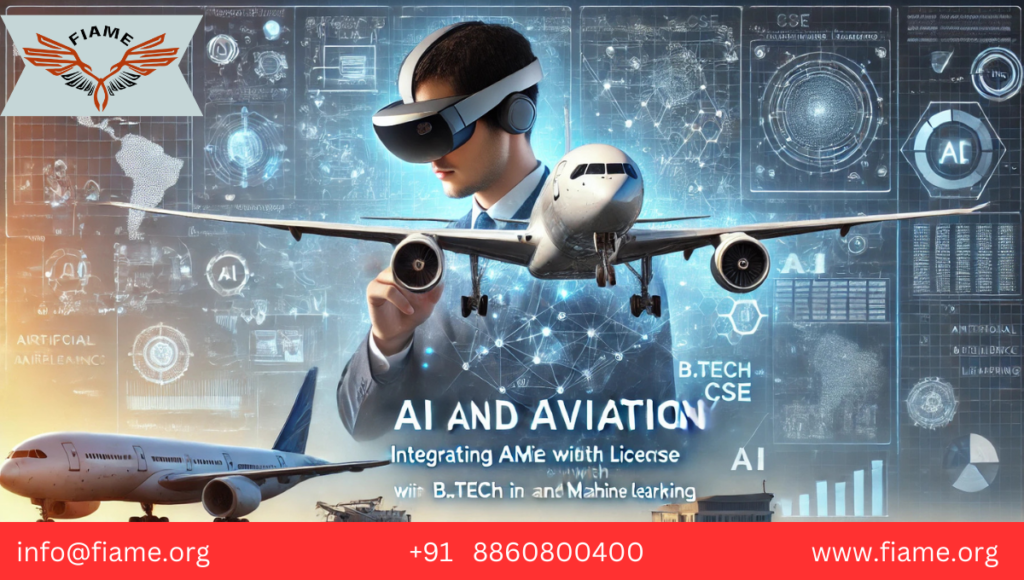
AI and Aviation: Integrating AME License with B.Tech in CSE (Artificial Intelligence and Machine Learning)
Posted on : 11 March, 2025 5:13 pm
The aviation industry is evolving rapidly, and technology plays a critical role in ensuring safety, efficiency, and innovation. The integration of Aircraft Maintenance Engineering AME with B.Tech in Computer Science Engineering specializing in artificial intelligence and machine learning presents a groundbreaking opportunity in the aviation industry. As AI continues to revolutionize aviation professionals with expertise in both aircraft maintenance and AI driven technologic will be in high demand.
What Is AME License
An Ame License (Aircraft Maintenance Engineering) is a professional certification that qualifies individuals to security, repair, maintain aircraft and ensure their airworthiness.it is issued by aviation regulatory authorities such as Directorate General of Civil Aviation(DGCA) in India.
What Is CSE (Artificial Intelligence And Machine Learning)
B.Tech in Computer Science Engineering (CSE) is a four-year undergraduate program that focuses on computer systems, programming, software development, artificial intelligence, cybersecurity, and data science.
The Role of AI in Aviation
Artificial intelligence is revolutionizing the aviation industry by enhancing safety,efficiency,and automation across multiple domains from aircraft maintenance to air traffic management.AI driven solutions are improving decision making, reducing human error, and optimizing operations, making aviation safer and more cost effective.
1. Predictive Maintenance: AI analyzes aircraft sensor data to predict component failures before they happen, reducing downtime and improving safety.
2. Air Traffic Management: AI assists controllers in managing complex flight schedules, reducing delays and enhancing efficiency.AI assists in optimizing flight routes and reducing congestion.Real-time data processing enables better decision-making for air traffic controllers.
3. Pilot Assistance and Automation: AI-powered autopilot systems enhance flight safety and reduce pilot workload.AI can analyze environmental conditions and assist pilots in making informed decisions.Human-AI collaboration ensures better situational awareness.
4. Customer Experience Enhancement: AI-driven chatbots handle passenger inquiries and provide real-time flight updates. Personalized travel experiences are possible through AI-powered recommendation systems. Facial recognition technology streamlines airport security and boarding processes.
The Importance of AME Licensing
The AME license is crucial for ensuring aviation safety, compliance and operational efficiency. Learning about aircraft structures, engines, avionics, and maintenance procedures. Gaining hands-on experience with aircraft systems and components. Understanding regulatory requirements and safety protocols. Combining an AME license with a B.Tech in CSE (AI & ML) allows professionals to leverage AI technology for advanced maintenance solutions.
Benefits of Integrating AME License with B.Tech in CSE
Combining an Aircraft Maintenance Engineering (AME) License with a B.Tech in Computer Science Engineering (CSE) Specializing in artificial intelligence and machine learning provides a unique and highly valuable skill set in the aviation industry. This integration enables professionals to bridge the gap between traditional aircraft maintenance and emerging AI driven aviation technologies.
1. AI-Powered Aircraft Maintenance: AI can automate routine inspections using image recognition and anomaly detection. Machine Learning models analyze engine performance, predicting necessary interventions. AME professionals with AI expertise can develop and refine these systems for better efficiency.
2. Enhanced Safety and Compliance: AI-driven tools help AMEs ensure regulatory compliance through automated record-keeping. Data analytics can detect patterns in maintenance logs, flagging potential issues.AI reduces human errors by cross-verifying maintenance tasks with historical data.
3. Career Opportunities in Aviation Technology: Graduates can work in AI-driven aviation research, developing smart maintenance solutions Opportunities exist in drone technology, automated inspections, and aviation cybersecurity.AI and ML specialists are in demand in aerospace manufacturing and airline operations.
4. Advancements in Autonomous Aircraft: AI-powered unmanned aerial vehicles (UAVs) are revolutionizing aviation. Engineers with AME and AI expertise can contribute to developing autonomous aircraft maintenance systems.AI-driven flight simulations aid in pilot training and aircraft testing.
How to Pursue AME + B.Tech in CSE (AI & ML)
- Eligibility: Must have passed 10+2 with Physics, Chemistry, and Mathematics (PCM) from a recognized board.
- Application: Apply online through FIAME official website or visit the admission office for an offline application.
- Merit-Based Selection: Admission is granted based on 12th-grade marks (minimum percentage requirement varies).
- Document Submission: Submit required documents like mark sheets, ID proof, passport-size photos, and other necessary certificates.
- Fee Payment: Pay the admission and tuition fees as per the institute’s guidelines.
- Enrollment Confirmation: Complete all formalities and receive an admission confirmation letter.
- Commencement of Classes: Attend the orientation and begin your academic journey.
The integration of AI and ML with Aircraft Maintenance Engineering is shaping the future of aviation. Professionals who combine technical aviation knowledge with AI-driven problem-solving skills will be at the forefront of this transformation. Pursuing an AME license alongside a B.Tech in CSE (AI & ML) not only enhances career prospects but also contributes to a safer, smarter, and more efficient aviation industry. With continuous technological advancements, the demand for AI-powered aviation solutions will continue to grow, making this interdisciplinary approach a promising pathway for the next generation of aviation engineers.