
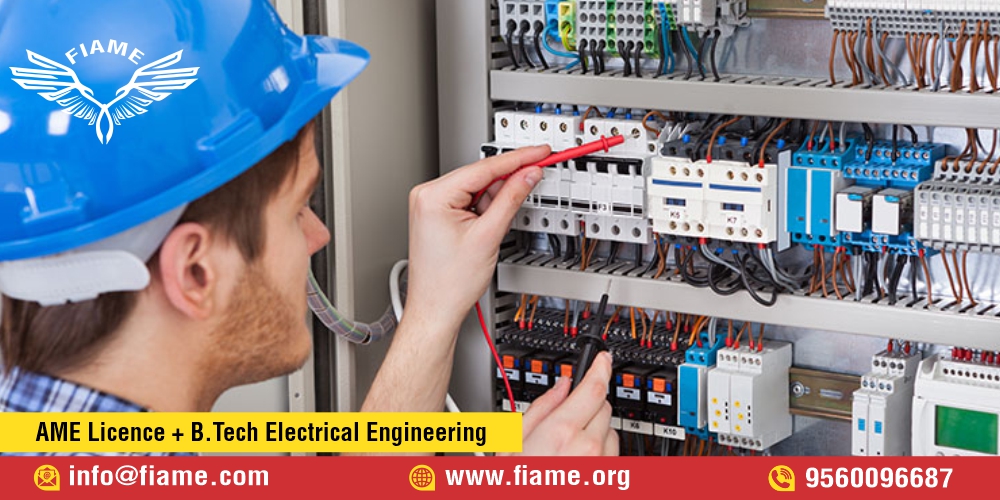
Harnessing Flight and Power: AME License with BTech Electrical Engineering
Posted on : 17 June, 2024 6:03 pm
Introduction
- An AME (Aircraft Maintenance Engineer) License and a BTech in Electrical Engineering are prestigious qualifications that open diverse career opportunities. The AME License equips individuals with the skills to inspect, maintain, and repair aircraft, ensuring their airworthiness and safety. This program covers topics like aviation regulations, aircraft systems, and maintenance practices. Meanwhile, a BTech in Electrical Engineering provides a robust foundation in electrical principles, circuit design, power systems, and electronics. This degree is critical for developing innovative solutions in various industries, including aerospace. Combining these qualifications enables professionals to bridge the gap between aviation maintenance and electrical engineering, offering unique expertise highly sought after in the aviation and technology sectors.
Career Paths and Opportunities
- Combining an AME License with a BTech in Electrical Engineering opens diverse career paths. Professionals can work as aircraft maintenance engineers, avionics specialists, and aerospace engineers, ensuring aircraft safety and efficiency. Opportunities also exist in electrical engineering roles, including power systems, electronics, and control systems. This dual expertise is highly valued in the aviation industry, defense sectors, and advanced technology firms, offering a competitive edge and diverse career options.
Challenges and Solutions
- Combining an AME License with a BTech in Electrical Engineering presents challenges such as rigorous study demands, balancing theoretical knowledge with practical skills, and meeting diverse industry standards. Solutions include structured time management, seeking internships for hands-on experience, and continuous learning to stay updated with technological advancements. Joining professional associations and networking with industry experts can also provide guidance and support, helping overcome these challenges effectively.
Future Trends and Technologies
- Future trends in combining AME and BTech Electrical Engineering include advancements in electric and hybrid aircraft, integration of AI for predictive maintenance, and the use of drones for inspection. Emerging technologies like IoT in aviation systems, enhanced avionics, and renewable energy solutions are transforming the industry. Staying updated with these innovations ensures professionals remain at the forefront, driving efficiency, sustainability, and safety in aviation and electrical engineering.
Hands-On Experience and Internships
- Hands-on experience and internships are crucial for combining an AME License with a BTech in Electrical Engineering. They provide practical skills, industry exposure, and a deeper understanding of aircraft maintenance and electrical systems. Internships at airlines, aerospace companies, and engineering firms offer real-world applications, networking opportunities, and mentorship. This practical experience bridges the gap between academic knowledge and professional expertise, enhancing career readiness and job prospects.
Technical Skills Development
- Developing technical skills is vital for success in both AME and BTech Electrical Engineering. Key skills include understanding aircraft systems, electrical circuit design, troubleshooting, and maintenance techniques. Hands-on training, simulation exercises, and lab work enhance proficiency. Continuous learning through workshops, certifications, and staying updated with industry advancements is essential. Mastery of these skills ensures high performance, safety, and innovation in both aviation and electrical engineering fields.
Tools and Technologies
- In AME and BTech Electrical Engineering, essential tools include diagnostic software, multimeters, oscilloscopes, and CAD software for design and analysis. Technologies like advanced avionics systems, IoT devices, and AI for predictive maintenance are pivotal. Drones for inspections, renewable energy solutions, and electric propulsion systems are also significant. Mastery of these tools and technologies ensures efficiency, safety, and innovation in aircraft maintenance and electrical engineering applications.